Ring Anatomy: A Simple Guide to Every Part
The shank is the band around your finger; the head holds the centre stone. Learning the smaller parts helps you compare side views, explain a design preference and ask better questions about fit and maintenance.
Reviewed by Adnan Ali, Graduate, GIA Diamond Grading · Updated 2026-10-21
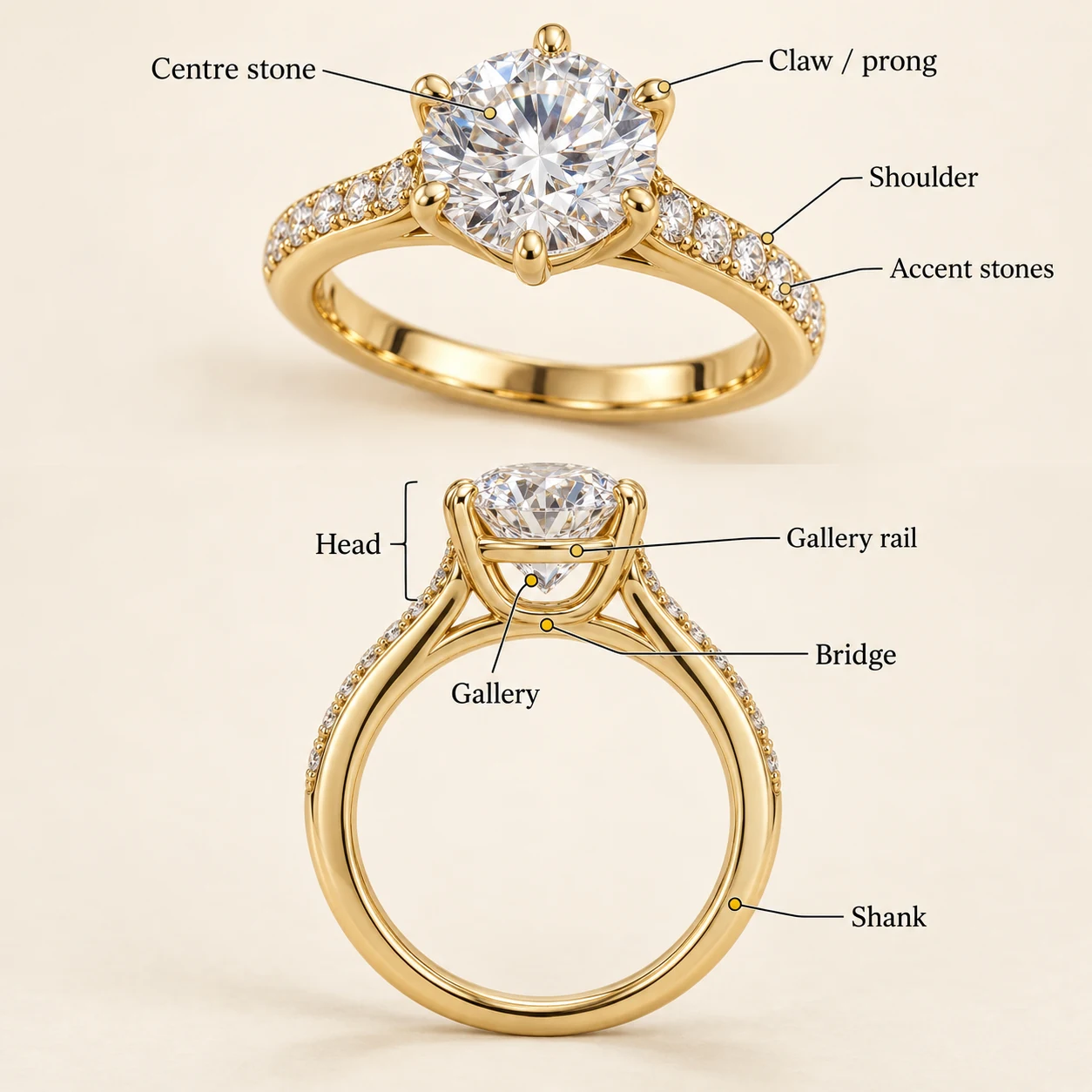
The parts of a ring, illustrated
This example is a claw-set engagement ring with a basket head and accent stones on its shoulders. Other designs combine or omit some of these features. Jewellers may use overlapping terms, so a marked photograph is often the clearest way to discuss a particular ring.
What each part means
| Part | Meaning | Why ask about it? |
|---|---|---|
| Centre stone | The main gemstone that forms the focus of the design. | Confirm its measurements as well as carat weight. |
| Claw / prong | A metal support and tip retaining a stone. | Ask how the shape and points of the stone are protected. |
| Head | The assembly that holds the centre stone. | Its height and construction affect the side view. |
| Gallery | The area and metalwork beneath the centre stone. | Look here to understand the setting from the side. |
| Gallery rail | A rail linking parts of the setting, often joining prongs. | Distinguish this support from a decorative hidden halo. |
| Shoulder | The upper part of the band approaching the head. | Check the shape and any stones on both sides. |
| Shank | The band that goes around the finger. | Ask for width, thickness and sizing guidance. |
| Bridge | Metal beneath the centre setting, over the finger, where present. | Check clearance for a neighbouring wedding band. |
| Accent stones | Smaller stones used around or beside the main stone. | Ask where they sit and how they are retained. |
Sources: GIA: ring setting components and styles
What should I look for in a side view?
Ask for a straight side view as well as the attractive top view. Look at how high the centre stone sits, how the head meets the shoulders, and what occupies the space beneath the diamond. A photograph cannot prove structural strength, but it can reveal details that need a clearer explanation.
- Where does the head connect to the band?
- Is the gallery open, partly enclosed or decorated?
- Are there small stones where a second ring could rub?
- How much clearance is there for the wedding band you plan to wear?
- Can the seller show the two rings together from the side?
Is a gallery rail the same as a hidden halo?
No. A gallery rail is a supporting metal element. A hidden halo is an arrangement of small stones seen mainly from the side or at an angle. Those stones may be set into a rail, but a plain rail is not a hidden halo, and adding sparkle does not by itself prove that a setting is stronger.
Is the shank the same as the band?
Usually, yes. “Shank” is the jewellery term for the part around the finger. “Band” is more conversational and can also mean a complete wedding ring. When comparing two rings, ask where their width and thickness are measured, because a tapering shank is not the same width all the way around.
Will a high setting always fit flush with a wedding band?
No. Overall height alone does not describe the space beside and beneath the head. The bridge, gallery, shoulders and the second ring’s width and depth all affect how they sit together. Ask to see your intended pairing; “high set” is not a promise of a flush fit.
Which parts need attention during wear?
Claws, small-stone settings and contact points between stacked rings deserve attention. Stop wearing a ring if a stone moves, a tip starts catching or the band becomes noticeably distorted. A jeweller can check whether the issue is a repair, a fit problem or a design concern; avoid trying to tighten stones yourself.
Sources: GIA: identifying sound jewellery construction
How to explain the ring you want
Use a photograph and describe the visible change: “a plain gallery rail”, “smaller rounded tips”, “a wider shank at the base” or “space for this wedding band”. Then ask what the change means for the complete design. This is more precise than asking only for a ring that is “delicate” or “low”.