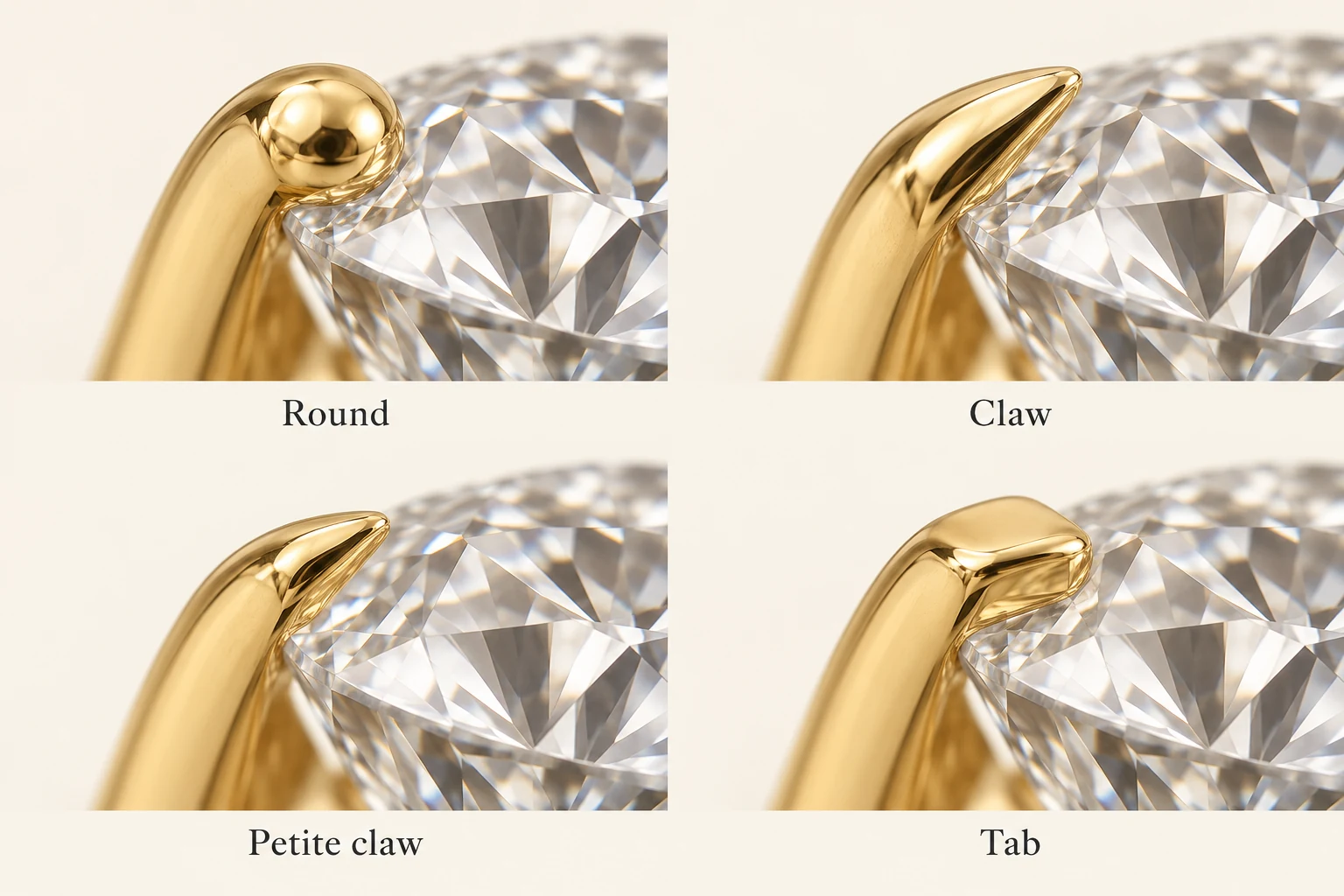
Prong Shapes: Round, Claw, Petite Claw and Tab
Round tips look softly beaded; claws taper to a point; petite claws are finer; tabs have a flatter, squared finish. Choose the look you like, then check the complete setting and how well it fits the stone.
Reviewed by Adnan Ali, Graduate, GIA Diamond Grading · Updated 2026-10-21
What is a prong, and is it the same as a claw?
A prong is a metal support that holds a gemstone in its setting. In UK jewellery descriptions, “claw” often means any prong; “claw-shaped tip” specifically means the tapered finish. The tip sits over the stone, while the seat supports its edge. Tip shape, prong count and the design of the head are separate choices.
Compare the four prong tip shapes
| Tip | Appearance | Ask before choosing |
|---|---|---|
| Round | A smooth, rounded bead over the stone. | Can I see the tips from above at normal viewing size? |
| Claw | An elongated tip that tapers towards the stone. | Are all tips even and neatly finished against the stone? |
| Petite claw | A smaller, finer single claw tip. | Is this size of tip suitable for this particular stone and setting? |
| Tab | A broader, flatter tip with a squared outline. | How much of the stone does the tab cover, and are its edges smooth? |
These are descriptive names, not universal dimensions. One jeweller’s petite claw may be another’s standard claw. Compare close-up photographs of the finished piece as well as the drawing, and ask whether the pictured tip is available on your selected design.
Which prong shape is most secure?
There is no universal winner based on tip shape alone. Stone fit, sound metal, the seat, tip contact and the condition of the whole setting matter. GIA’s workmanship guidance checks these details rather than treating a fashionable outline as a guarantee. A finer-looking tip should still leave enough metal for its job.
Pointed diamond corners need particular attention. A V-prong can shelter a princess-cut corner or the point of a pear or marquise; it is different from a pointed claw tip. Ask how vulnerable points are protected and whether the chosen head suits the exact stone.
Sources: GIA: workmanship checks to help avoid stone loss · GIA: protecting a diamond engagement ring
How to choose for everyday wear
- Start with the top view: round for a softer outline, claw for a tapered finish, tab for a more geometric detail.
- Check a side view too. A low-looking tip does not necessarily mean the whole ring sits low.
- Compare the complete ring at actual size. Extreme magnification can make tiny differences seem much larger.
- If you wear gloves or textured knitwear frequently, ask to feel the finished setting for catching edges.
- Ask about inspection and future maintenance before requesting especially delicate tips.
Do claw prongs snag more than round prongs?
A pointed outline does not tell you how a finished ring will behave. A raised, rough or damaged tip can catch fabric regardless of its shape. New or persistent snagging is a reason to stop wearing the ring and have the setting checked; do not bend or file the tip yourself.
Are four or six prongs better?
Count changes the appearance and arrangement of support, but it does not certify security. Compare four- and six-prong versions on the same stone shape, and ask the jeweller why the proposed arrangement is suitable. Tip style alone cannot answer that question.
Can I change round prongs into claws later?
Sometimes, but it depends on the existing metal and construction. Reshaping can remove metal, and a worn or unsuitable head may need rebuilding or replacement. Ask for an assessment and quote before buying a ring on the assumption that changing its tips will be simple.
Questions to ask before ordering
- Which tip shape and number of prongs are included in this design?
- Can I see a top view and a side view of the finished style?
- How are pointed corners protected?
- What should I do if a tip catches or a stone appears to move?
Sources: Stuller: claw-prong settings and stone seats