Ring Profiles: Court, D-Shape, Flat and Comfort Fit
A ring profile is the shape of the band’s cross-section. Compare the outside appearance and the surface against your finger separately, then try the width and depth you intend to wear.
Reviewed by Adnan Ali, Graduate, GIA Diamond Grading · Updated 2026-10-21
What is a ring profile?
Imagine cutting across a plain band and looking at the cut end. That outline is its profile. The outer surface changes the look of the ring; the inner surface changes how it meets your finger. Profile is separate from ring size, band width, metal and surface finish.
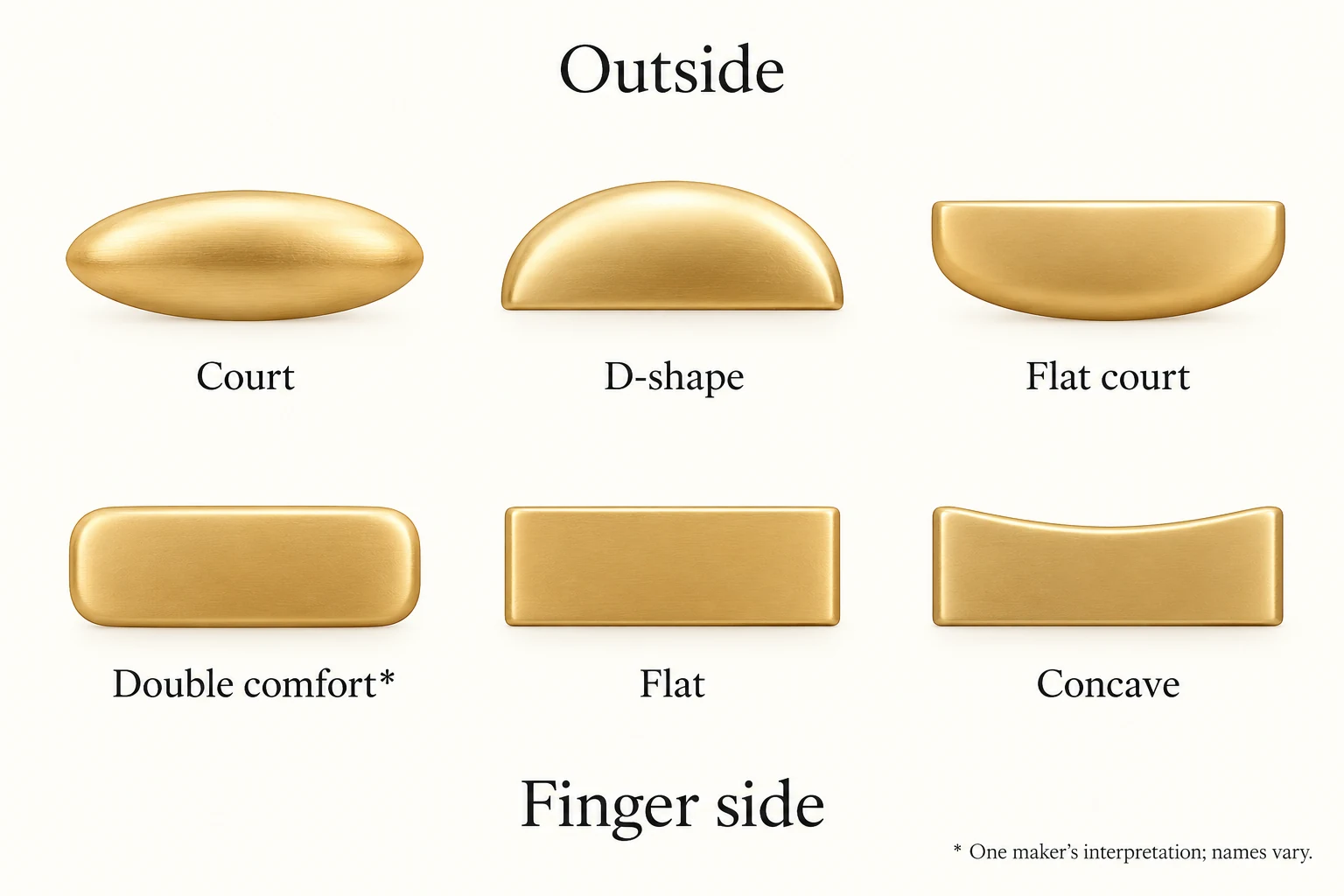
Compare six common profile names
| Profile | Outside | Inside / naming note |
|---|---|---|
| Court | Rounded | Rounded; often described as a traditional comfort fit. |
| D-shape | Domed | Flat; the section resembles a D on its side. |
| Flat court | Flat | Rounded. |
| Flat | Flat | Flat; edge finishing still varies. |
| Double comfort | Varies by maker | The illustrated example has flat faces and softened corners. Ask for a section drawing. |
| Concave | Dips inward across its width | May be flat or rounded; the name describes the outside. |
Court does not normally mean a perfectly circular wire section. Likewise, “double comfort” is not a universal peanut-shaped profile. Wedding Rings Direct, for example, uses that name for flat inner and outer faces with softened corners. Treat a manufacturer’s section drawing as more informative than a name alone.
Sources: Wedding Rings Direct: profile definitions and examples
Profile, width, depth and size: four separate choices
- Profile: the shape of the cross-section.
- Width: how much of your finger the band covers along its length.
- Depth / thickness: how far the metal stands above the finger.
- Ring size: the size of the opening that fits around your finger.
When comparing samples, keep the other dimensions similar. A broad, deep court ring and a narrow, shallow D-shape do not isolate the effect of profile. Ask for the measured width and depth alongside the profile name so that you know what you are comparing.
Which ring profile is most comfortable?
There is no single answer for every hand. Try the ring on, close your hand, bend your finger and notice the edges against neighbouring fingers. If it will be worn beside another ring, try the pair together. Make your decision from the actual fit and movement, not from the word “comfort” on a label.
Do comfort-fit rings need a different size?
Do not automatically move up or down a fixed amount. Width and the inner shape can change how a ring feels, so have the fit checked using a sample close to your intended design. A size measured with a slim sizer may not describe the feel of a much wider band.
Must my wedding ring match my engagement ring’s profile?
No. Matching is an aesthetic choice. Compare the two rings’ heights, edges and contact points as well as their colour and finish. Ask to see them together from above and from the side, and check that they feel comfortable as a pair.
Is a flat profile the same as a matt finish?
No. Flat describes shape; matt, satin, brushed and polished describe the surface appearance. A flat ring can be highly polished, and a domed ring can have a satin finish. Ask about both when specifying a design.
Questions to ask before ordering
- Can I see a cross-section or a sample of this exact profile?
- What are the finished width and depth in millimetres?
- Is the inside flat or rounded, and how are the edges finished?
- Can I check the fit at the intended width?
- How will it sit against the other ring I plan to wear?
- What sizing changes are possible for this particular metal and design?
The profiles here are general examples, not a promise that every shape is offered on every Xclusive Diamonds design. Confirm the specification of the ring you choose before ordering.