Jewellery Polishing: How a Beautiful Finish Is Made
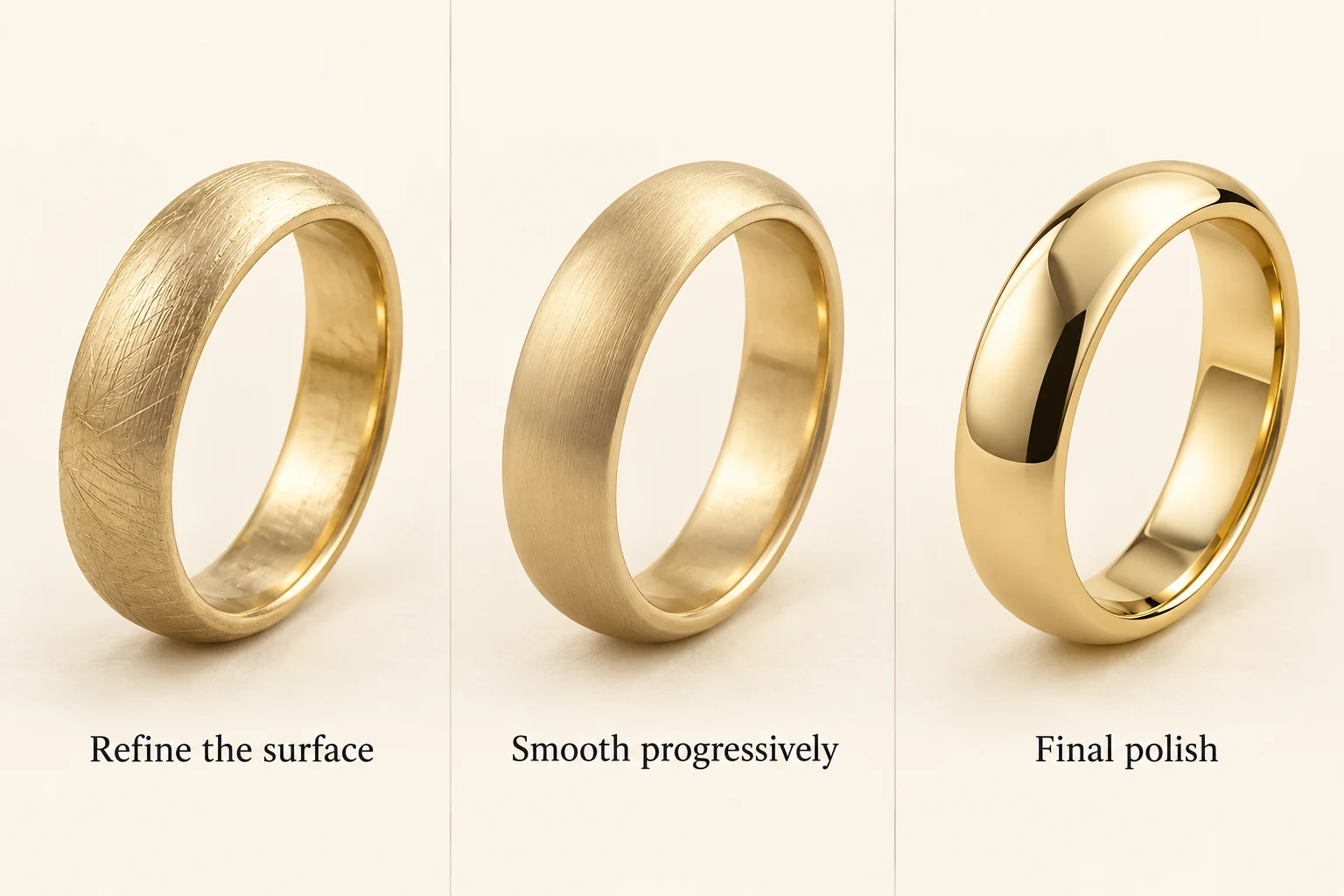
Jewellery polishing refines the metal surface so it reflects light evenly and feels smooth. A beautiful finish starts with accurate shaping and careful preparation, followed by progressively finer work. The aim is to enhance the surface while preserving the piece’s contours and delicate details.
Reviewed by Adnan Ali, Graduate, GIA Diamond Grading · Updated 2026-10-21
What does jewellery polishing do?
This guide is about finishing the metal of a piece of jewellery. Diamond cutting and polishing are separate crafts. A bright metal surface can complement a diamond, but polishing the ring does not change the diamond’s cut grade.
How is jewellery polished?
- 1. Establish the shape. Filing and preparation refine the contours and remove excess metal left from earlier work.
- 2. Refine the surface. Abrasives reduce marks progressively rather than expecting the final buff to remove every scratch.
- 3. Reach the details. Small tools and an appropriate sequence help finish recesses and areas that will be harder to reach after assembly or setting.
- 4. Develop the finish. Suitable compounds and buffs bring out the chosen surface appearance. Tools and techniques are selected for the metal and design.
- 5. Clean and examine. Residue is removed so the finish can be assessed properly, including the inside and less visible surfaces.
There is no single compound or sequence for every alloy. Platinum finishing, for example, needs techniques and tools suited to platinum; borrowing an abrasive sequence from a different metal can produce disappointing results.
Sources: Stuller Technical Team: platinum finishing procedures
Why does a good polish take skill?
| Challenge | The risk | The aim |
|---|---|---|
| Deep preparation marks | A surface may become shiny while deeper scratches remain. | Correct preparation before the final polish. |
| Fine edges and details | Excessive work can round edges or reduce small features. | Keep the intended shape, definition and sufficient metal. |
| Narrow spaces | An attractive outer surface can distract from unfinished recesses. | Plan access and use tools appropriate to each area. |
| Different metals or finishes | The same treatment may affect adjacent areas differently. | Preserve the intended contrast and use a suitable process. |
| Residue or contamination | Remaining compound or coarse particles can spoil the final result. | Clean appropriately between stages and before assessing the finish. |
Prefinishing is the preparation that makes the later polish effective. It is also where shape must be protected: a flat surface should remain flat, and a deliberate curve should keep its form. More shine is not a reason to erase the design.
Sources: GIA: prefinishing and retaining the intended form
How does Xclusive Diamonds achieve the finished look?
The Xclusive Diamonds making process includes hand-filing and truing the raw casting, followed by hand-setting and finishing. Filing cleans the edges and restores the intended contours; sanding and polishing then develop the surface finish. Each finished piece is checked against the order before dispatch.
That relationship between shape and surface is what matters to the customer. A polished shoulder should still flow neatly into its setting, the band should retain its intended outline, and the finished piece should feel comfortable as well as look beautiful. Our Craftsmanship page describes balance and wearability as part of how a piece is judged.
Does every piece need a mirror polish?
No. A high polish gives a reflective appearance, while a deliberately satin or brushed finish has a softer look. Neither is automatically the better choice. Confirm the finish included in your selected design, and ask about any change before ordering: availability depends on the piece.
What is the difference between cleaning, polishing and plating?
Cleaning removes deposits such as dirt and residue. Abrasive polishing refines the metal surface and can remove some metal. Plating adds a thin surface layer of another metal. These are different services, so describe the result you want and ask what work your piece actually needs.
Can polishing remove every scratch?
Not always appropriately. Removing a deep mark may require taking away too much surrounding metal or changing an important detail. A jeweller should assess the piece before recommending a polish, repair or leaving a minor wear mark alone. A new-looking shine is not a substitute for sound construction.
How often should jewellery be professionally polished?
There is no universal schedule. It depends on wear, the finish, construction and condition. Ask for an assessment rather than automatically requesting a heavy polish at every clean. Fine details and settings deserve particular care.
How can I keep the finish looking good?
- Follow the care instructions for the complete piece, including any stones and surface treatments.
- Store pieces separately so they do not rub against one another.
- Remove jewellery for activities that can cause knocks or abrasion.
- If a setting catches or a stone moves, stop wearing the piece and arrange an inspection.
- Ask for advice before using abrasive products or home polishing equipment.
Sources: GIA: protecting a diamond engagement ring
Questions to ask about your finish
- Is this design supplied with a high polish, satin finish or a combination?
- Which details should be preserved if I have it refinished later?
- Does the piece have any surface treatment that affects its care?
- Would cleaning alone achieve the result I want?