Jewellery Casting: From a Model to a Finished Piece
Jewellery casting turns a model into a metal form. In lost-wax casting, the model is removed from a heat-resistant mould and molten metal takes its place. The casting then needs careful preparation, stone setting and finishing before it becomes jewellery you can wear.
Reviewed by Adnan Ali, Graduate, GIA Diamond Grading · Updated 2026-10-21
What is jewellery casting?
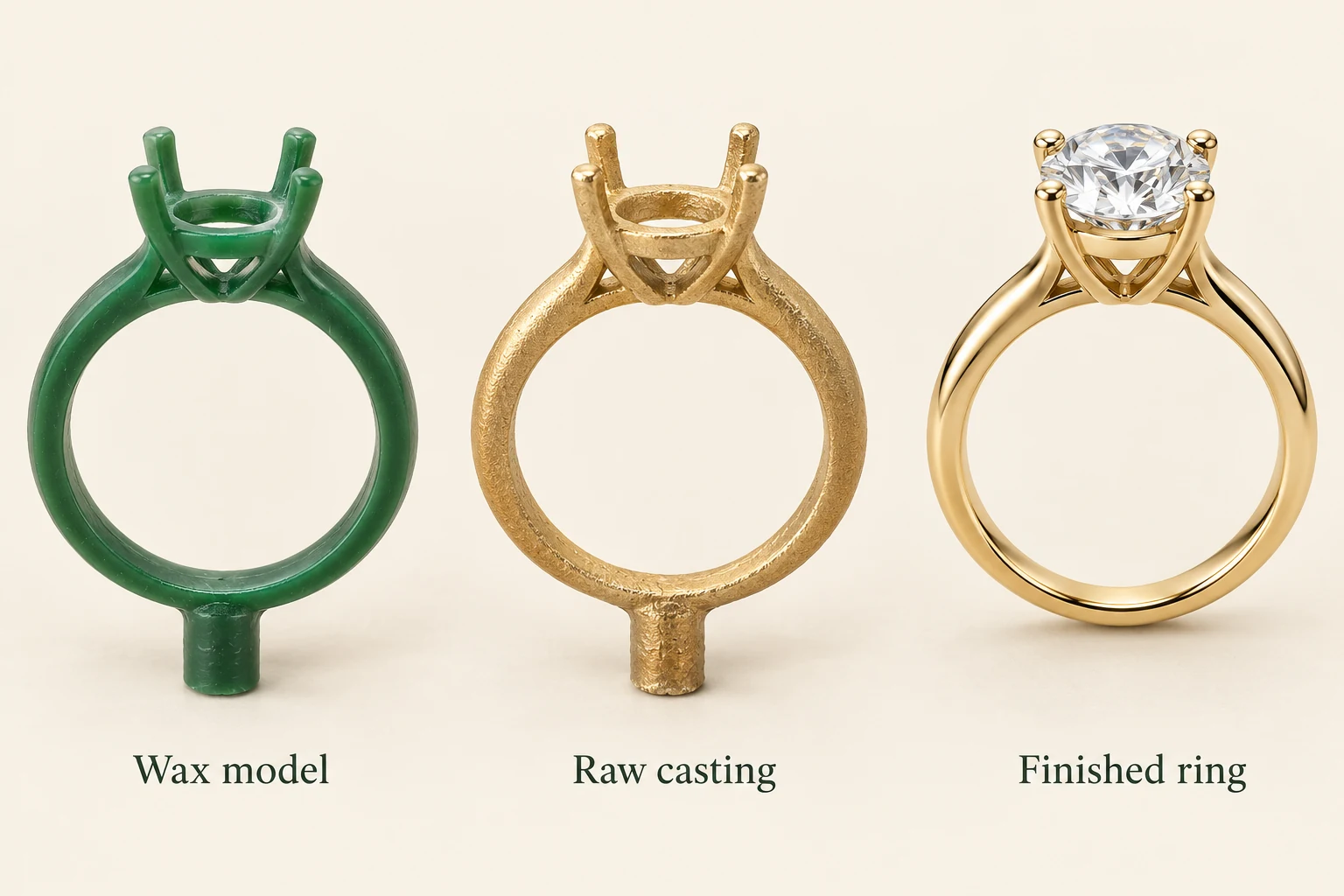
Casting creates the main metal shape of a piece, such as a ring’s band and setting. It can reproduce intricate forms, but the newly cast metal is only a starting point: feed channels, surface texture and unfinished setting details still need attention.
How does the casting process work?
- 1. Prepare the model. A wax or suitable castable pattern represents the design. Its proportions must allow for the later making stages.
- 2. Add feed channels. Sprues connect the pattern to the route through which metal will enter; several patterns may share a casting tree.
- 3. Make the mould. A heat-resistant material called investment surrounds the pattern inside a flask and sets.
- 4. Remove the pattern. A controlled burnout cycle clears the pattern material and prepares the mould.
- 5. Cast and cool. Molten alloy enters the cavity, solidifies and is allowed to cool according to the process.
- 6. Reveal the casting. The investment is removed, the cast pieces are separated from their feed channels, and preparation for finishing begins.
The pattern material, alloy, investment and equipment determine the appropriate temperatures and timings. This is an explanation of the sequence, rather than a universal casting recipe.
Sources: Rio Grande: the lost-wax casting process
What makes jewellery casting difficult?
| Challenge | Why it matters | How it is addressed |
|---|---|---|
| Incomplete detail | Fine sections may not fill properly, leaving an incomplete shape. | Review the model, feed routes and casting conditions; assess whether the piece needs to be recast. |
| Porosity | Small voids or pits can affect the surface and the soundness of a component. | Investigate the casting conditions and metal feed, and assess the defect before further work. A bright polish alone does not establish sound metal. |
| Roughness or unwanted fins | Mould problems can transfer unwanted texture or thin metal projections to the casting. | Control investment preparation and burnout, then distinguish removable surface excess from defects that require a new casting. |
| Loss of detail during cleanup | Removing excess metal can also soften intentional edges or fine features. | Refine locally and preserve the intended contours instead of simply removing more material. |
These are general manufacturing challenges, not a claim that every piece develops them. Finding a problem early matters: proceeding to set diamonds into an unsuitable component would add work without resolving its underlying condition.
Sources: Ransom & Randolph: casting technical support and defect guides · GIA: examining jewellery workmanship
How does Xclusive Diamonds turn a casting into finished jewellery?
At Xclusive Diamonds, casting is carried out by an external caster. The making process described on our Craftsmanship page begins with a CAD design adjusted to the order’s size and specification. Casting establishes the form; the work that follows gives the piece its finished character.
The raw casting is filed and trued by hand: edges are cleaned and contours brought back to the design. Stones are then individually seated, levelled and secured under magnification. Surfaces are sanded and polished, and the finished piece is checked against the order before dispatch.
This sequence addresses different jobs in turn. Hand-filing refines the shape left by casting; individual setting fits the stones; polishing develops the finish. Together, these stages create the clean outlines, balanced stone arrangement and smooth feel that make the finished jewellery rewarding to wear.
What should you look for in the finished piece?
- View it from the top and side: does the shape look balanced and match the design you ordered?
- Look at the inside and underside as well as the most visible surfaces.
- Check that intentional details remain clear and edges feel comfortable.
- Confirm your chosen metal, size and other order details.
- Ask us about a rough patch, visible pit or unexpected detail rather than trying to file or polish it yourself.
Can cast jewellery also be finished by hand?
Yes. Casting describes how a metal form is produced; hand-filing, setting and polishing describe subsequent work. A cast piece can involve substantial skilled handwork. Ask what was done at each stage rather than relying on a single label such as “handmade”.
Is cast jewellery lower quality?
Casting alone does not determine quality. The design, condition of the metal, fit of the stones and standard of the finishing all matter. Compare the actual finished piece and its construction, rather than assuming that a manufacturing label guarantees a result.
Are the diamonds cast into the metal?
The Xclusive Diamonds process described here places hand-setting after casting and filing. Other manufacturing methods exist, but the illustration shows this separate setting stage. See our diamond-setting guide for how the metal supports and secures a stone.
Questions to ask before ordering
- How does my chosen design suit the metal and size I want?
- Which parts of the design can be customised?
- Can you explain the finishing and setting details I will receive?
- Who should I contact if I want a detail checked after delivery?