Earring Backs: Push, Screw, Locking and Ball
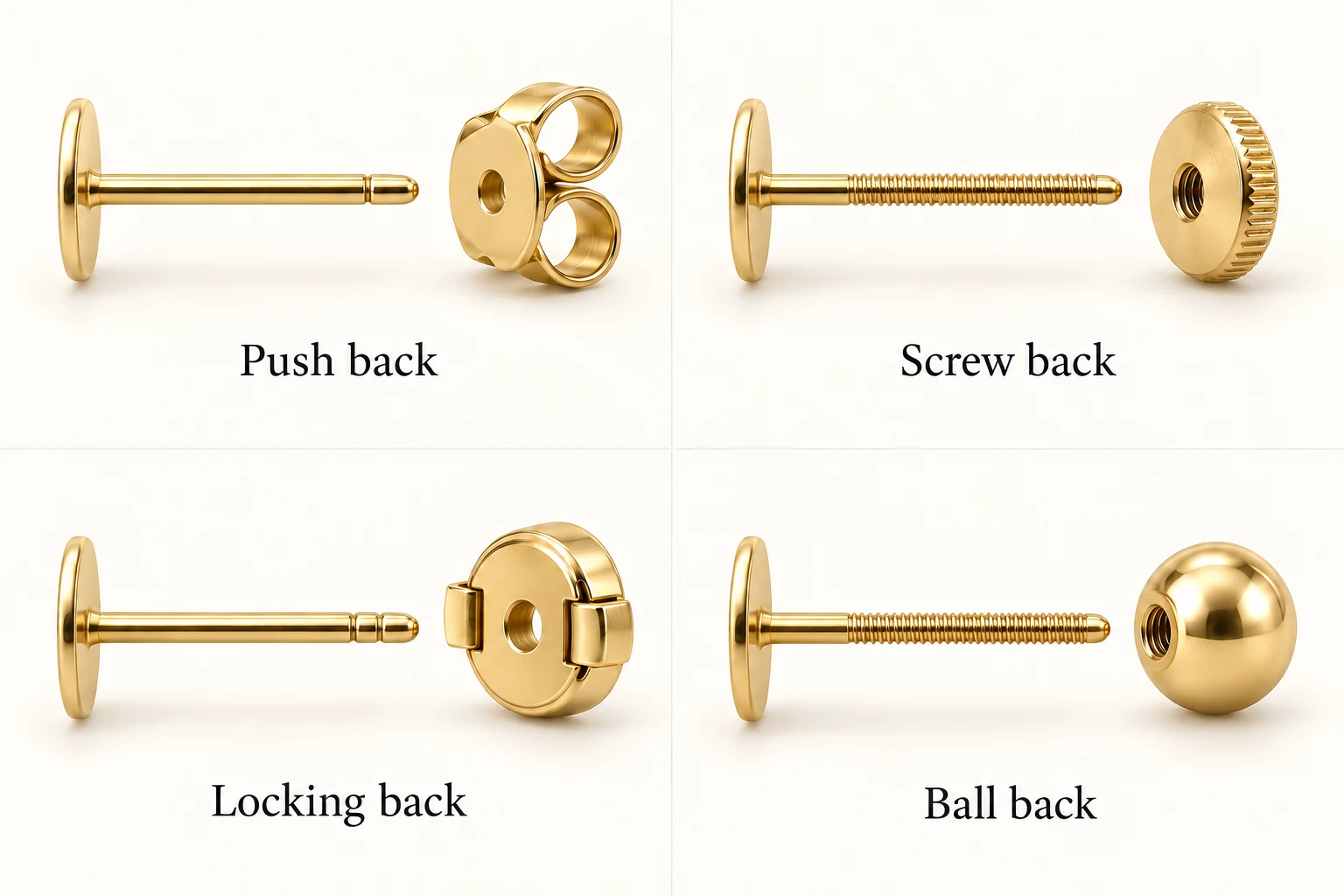
Choose an earring back by its fastening mechanism, its fit on the post and how easily you can use it. A round or butterfly-shaped back can hide different mechanisms; its shape alone does not tell you how it locks.
Reviewed by Adnan Ali, Graduate, GIA Diamond Grading · Updated 2026-10-21
Which earring back should I choose?
For straightforward daily handling, try a correctly fitted push back. If you prefer a fastening that must be deliberately undone, compare screw and locking systems. For heavier studs, ask about support as well as retention. Try fastening and removing the actual design yourself: the best option is one you can use confidently and comfortably.
How the four types work
| Type | How it fastens | What to check |
|---|---|---|
| Push / friction back | Slides onto a matching smooth post and holds by tension; often a butterfly or scroll shape. | Does it grip properly without being forced? |
| Screw back | A threaded back turns onto a matching threaded post. | Can you comfortably turn it, and does it engage without cross-threading? |
| Locking / safety back | An internal catch engages a matching notched post; a release mechanism lets it come off. | Can you operate the release and identify when it is engaged? |
| Ball back | A rounded outer shape, often with a threaded fastening. | What is the actual mechanism, and which post fits it? |
Guardian II® and Protektor® are named systems, not generic names for every locking back. Their manufacturers specify compatible posts. Some threaded designs push on and screw off, so always follow the instructions supplied with your particular pair.
Sources: Stuller: earring back mechanisms and matching posts
Check fit and comfort before buying
- Ask to see the back next to the post, not just the front of the earring.
- Handle both earrings over a tray or soft surface so a small backing cannot roll away.
- Check whether your fingers can grip the back comfortably; tiny parts can be fiddly.
- Ask about post length and backing size if a stud tilts or feels unsupported.
- Confirm the metal of both the post and the back, especially if you already know you react to particular jewellery materials.
- Ask how to obtain the correct replacement back and whether it is sold separately.
A tight back is not a substitute for a proper fit. It should hold the earring without pinching the ear. If fastening requires force, stop and ask the seller to check the pairing. This guide describes jewellery components, not instructions for new or healing piercings.
Can I put any earring back on any post?
No. Similar-looking parts can have different post diameters, thread pitches or locking grooves. A back that initially slides on may still be unsuitable. Take the earring or its exact specification to the jeweller when replacing a missing back; do not test compatibility by forcing it.
Are screw backs safer than push backs?
A screw fastening needs to be undone rather than simply pulled off, but no back prevents every loss. A worn, mismatched or incompletely fastened component can fail. Compare the actual construction and your ability to fasten it properly instead of relying on “most secure” as a universal label.
Does a ball back always screw on?
No. “Ball” describes the outside shape. Ask whether the design screws, pushes or locks onto its post and how it is released. A smooth-looking cover does not prove that different backs are interchangeable.
What should I do if an earring back becomes loose?
Remove the earring and have the back and post checked before wearing it again. Keep both components together. Do not squeeze, bend or glue a backing as a permanent repair, and do not replace a threaded part with an unverified push back simply because it seems to fit.
Your order checklist
- Exact fastening type and instructions.
- Matching post and back specification.
- Comfort when putting on and removing both earrings.
- Support for the chosen stud size and weight.
- Replacement availability and care instructions.