Bracelet Clasps: Nine Fastenings Explained
A good bracelet clasp suits the bracelet’s weight, fits its connecting parts and is easy for you to close fully with one hand. Compare the mechanism and any safety catch, not just the clasp’s shape.
Reviewed by Adnan Ali, Graduate, GIA Diamond Grading · Updated 2026-10-21
Identify your bracelet clasp
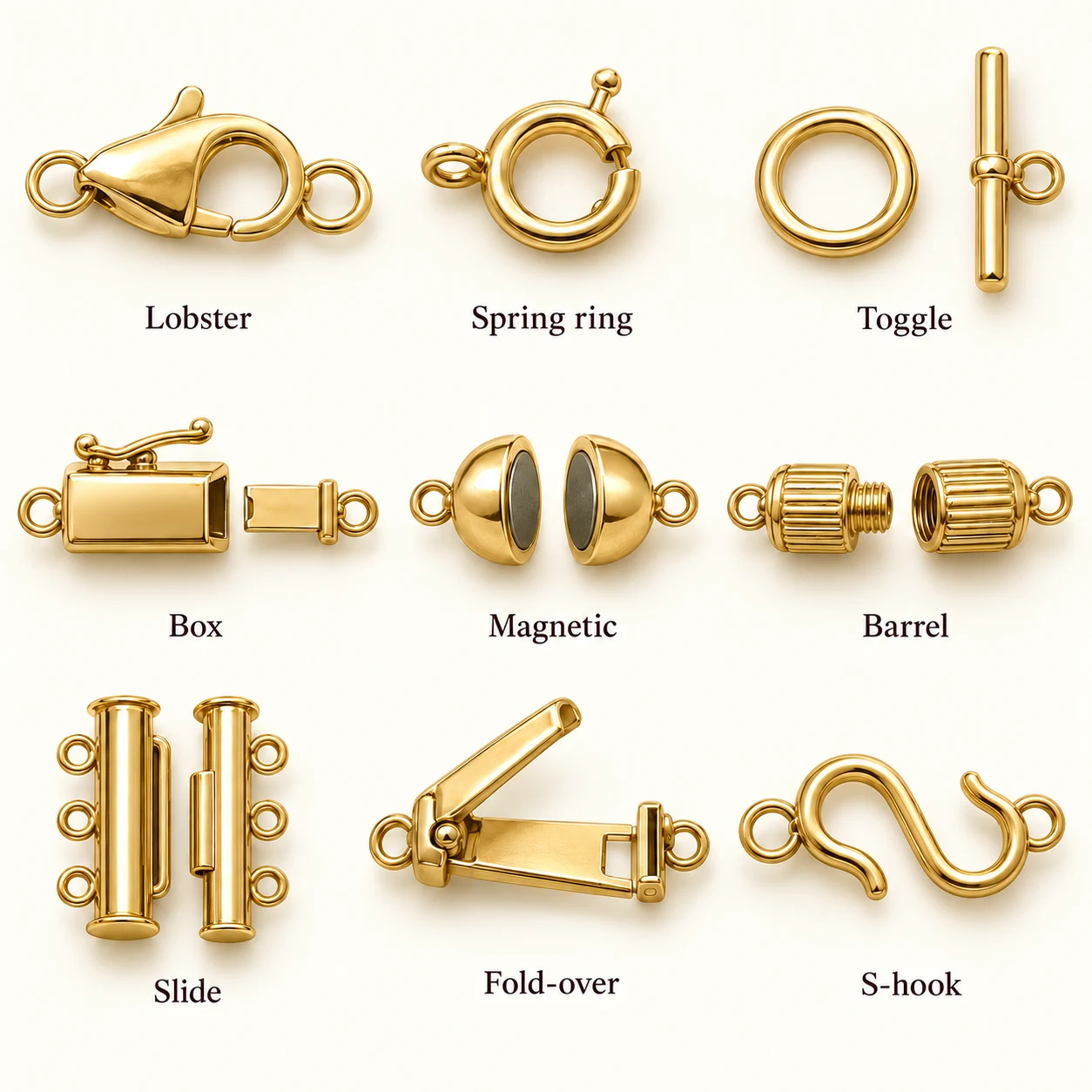
Clasps join the ends of a bracelet. The same families appear on necklaces, but a bracelet normally has to be fastened one-handed. “Slide”, “barrel” and “safety clasp” can describe more than one construction, so ask to see the actual fastening open and closed.
Compare nine common clasp types
| Clasp | How it closes | Practical check |
|---|---|---|
| Lobster | A spring-loaded lever opens a gate onto a receiving ring. | Can you operate the lever and see the gate close completely? |
| Spring ring / bolt ring | A small lever retracts a section of a circular clasp. | Try the small lever with one hand. |
| Toggle | A bar passes through a ring and turns across it. | Check that the bar cannot slip back through during ordinary movement. |
| Box | A tongue slots into a housing and catches; some have a separate safety latch. | Check the main catch and every additional safety catch. |
| Magnetic | Magnetic attraction brings two ends together; some add a mechanical lock. | Ask how it resists a pull or sideways knock. |
| Barrel / screw | In the threaded version, two halves screw together. | Can you turn the halves without twisting the bracelet excessively? |
| Slide | Matching parts slide together and engage a stop or lock. | Confirm how the lock engages and releases on this model. |
| Fold-over | A hinged arm folds across a receiving part and clips shut. | Check that it closes flush and does not lift accidentally. |
| S-hook | An S-shaped hook connects receiving rings. | Look at the openings and whether a ring can work free. |
Sources: Fire Mountain Gems: clasp style reference · AZ Findings: clasp types and mechanisms
Choose for the way you wear your bracelet
- For a tennis bracelet or another valuable piece, ask about the main lock and any additional safety catches, then practise using them.
- If small levers are difficult, compare larger controls and ask for a demonstration of alternatives.
- If you prefer a decorative toggle or hook, test the fit and slack on your wrist; a good-looking clasp still needs to remain engaged.
- For multi-strand designs, check that the clasp keeps the strands aligned without tangling.
- For a gift, consider whether the recipient will be able to fasten it independently.
What does a safety catch do?
A safety catch is an additional fastening intended to help retain the bracelet if the main closure opens. It might be a hinged side latch or another locking feature. It must be fastened too, and it does not repair a worn main clasp. Ask the seller to demonstrate the closing sequence rather than assuming that a click means every part is secure.
Which clasp is easiest to use one-handed?
That depends on the control size, your grip and the bracelet. A small screw barrel can be awkward to turn, while tiny spring levers can be difficult to reach. Try the actual bracelet seated at a table. Check both putting it on and taking it off before choosing by appearance.
Are magnetic clasps suitable for every bracelet?
No. Magnet strength, bracelet weight and any extra mechanical lock all matter. Ask the maker whether that clasp suits the piece and how it should be opened. Do not assume that two ends attracting each other proves they will remain joined during wear. Follow the clasp maker’s restrictions for magnetic components.
A quick check before wearing
- Close the main clasp and any safety catch in the demonstrated order.
- Look for a gap, bent part, damaged link or latch that no longer sits properly.
- Check the connecting rings as well as the clasp body.
- Use only a gentle check of engagement; do not pull hard to “test” its strength.
- If it opens unexpectedly or no longer catches positively, stop wearing it and arrange an inspection.
Can a bracelet clasp be replaced?
Often it can, but the replacement must suit the bracelet’s metal, end fittings, proportions and weight. A different clasp can also change the finished length. Ask for a repair assessment and confirm the resulting fit; a clasp change is not always a simple swap.