Diamond Ratios: Choose the Shape That Suits You
Use recommended ratios to compare fuller and slimmer diamond shapes, then check the size, sparkle and outline you prefer.
Reviewed by Adnan Ali, Graduate, GIA Diamond Grading · Updated 2026-10-18
A diamond’s length-to-width ratio tells you how long it looks compared with its width. A higher number usually means a longer, slimmer outline. It is a useful way to describe the look you want; it is not a sparkle score.
Recommended ratios by shape
Use these ranges as a starting point, then compare real stones. There is no single optimum ratio that guarantees a beautiful diamond. The elongated-cushion range below is a practical comparison range, rather than a laboratory standard.
| Shape | Recommended starting range | What to look for |
|---|---|---|
| Oval | 1.33–1.66 | A balanced oval; try around 1.45 first, then compare fuller and slimmer outlines. |
| Pear | 1.50–1.75 | A balanced drop with even shoulders and a centred point. |
| Marquise | 1.75–2.25 | An elongated outline with aligned tips and balanced sides. |
| Emerald | 1.35–1.50 | A balanced rectangle with even corners and clear, broad reflections. |
| Elongated radiant | 1.25–1.40 | A rectangular outline with balanced corners and attractive sparkle. |
| Square cushion | 1.00–1.04 | An almost square outline with balanced, rounded corners. |
| Elongated cushion | Around 1.15–1.35 | Our practical comparison range for a longer cushion; a style preference rather than a laboratory optimum. |
| Princess | 1.00–1.04 | An almost square outline with balanced sides. |
| Asscher | 1.00–1.04 | An almost square, stepped outline with even cropped corners. |
| Heart | Around 1.00 | Similar length and width, matching lobes and a clear cleft. |
| Round | Around 1.00 | Similar diameters in each direction; use cut quality to assess light performance. |
How to read the number
An oval that measures 9 mm long and 6 mm wide has a ratio of 1.50, because 9 ÷ 6 = 1.50. Use the face-up length and width on the report, not the third measurement, which is depth. A ratio close to 1.00 means similar length and width.
What will it look like on your hand?
A longer diamond may cover more of your finger from top to bottom while looking narrower across it. Compare the measurements in millimetres as well as carat weight: two stones of the same weight can look different in size. Ask for images at the same scale or a view on a hand.
Check the sparkle as well as the outline
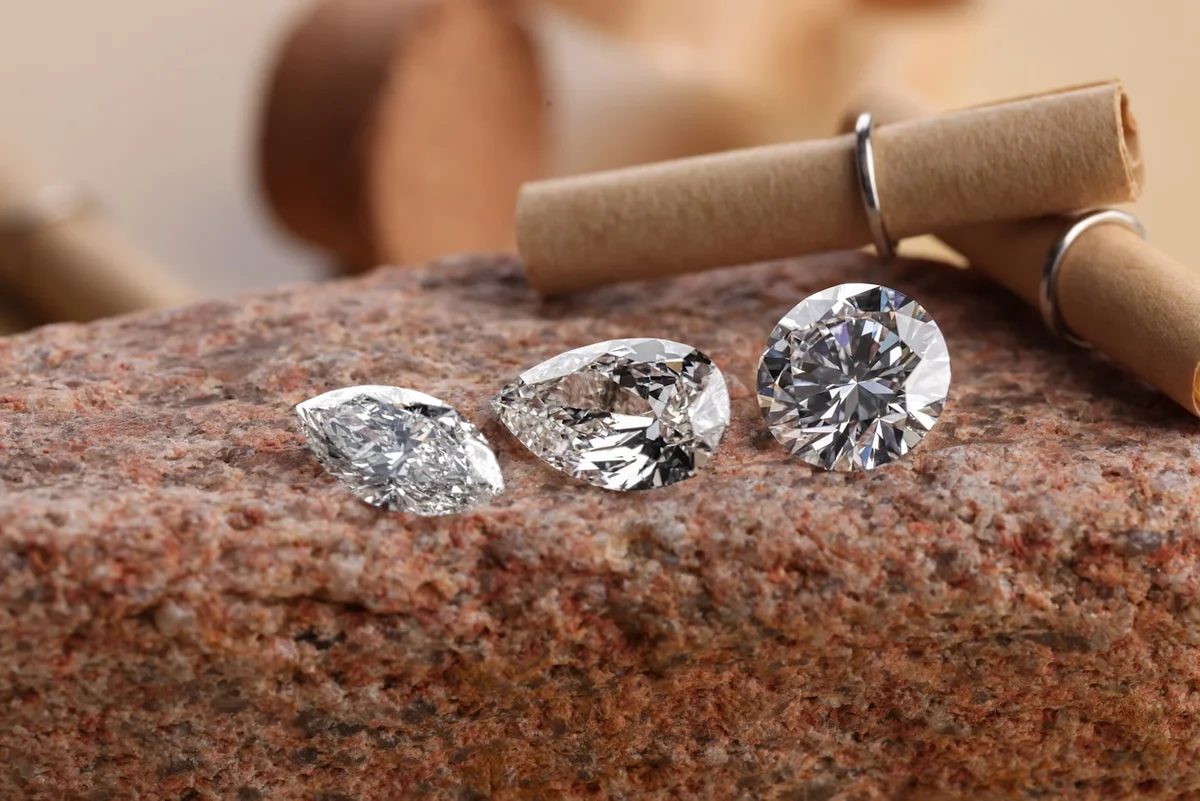
Two diamonds with the same ratio can have different curves, corners and sparkle. Watch a video as the stone moves. In oval, pear and marquise diamonds, look for a dark band across the centre, often called a bow tie. Some changing contrast is normal; a wide area that stays dark may be distracting.
Before you choose
- Pick a fuller or slimmer outline based on what you enjoy wearing.
- Compare actual length and width, not just carat weight.
- Check that curves, sides and pointed ends look balanced.
- Ask to see the chosen stone move in ordinary light before deciding.
Sources: GIA: oval diamond proportions · GIA: research on oval, pear and marquise appearance · IGI: fancy-shape cut assessment · GIA: outline proportions for fancy shapes · Diamond Screener: published ratio analysis