Diamond Inclusions: How Much Clarity Do You Need?
Understand common marks inside diamonds, what clarity grades mean, and when paying for a higher grade may make a visible difference.

Reviewed by Adnan Ali, Graduate, GIA Diamond Grading · Updated 2026-10-18
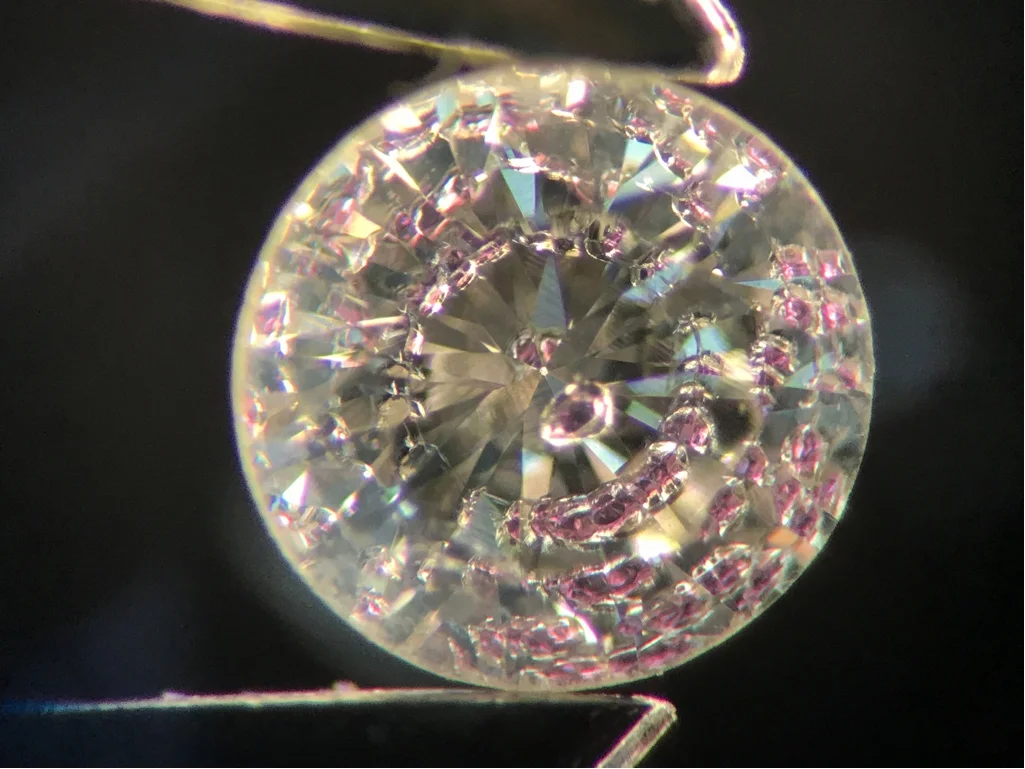
Inclusions are features inside a diamond. Clarity grades describe how noticeable internal features and surface marks are under ten-times magnification, written as 10×. For a buyer, the useful questions are whether you can see a mark, whether the diamond looks clear and whether any feature needs extra care.
Common inclusion names, simply explained
| Name | What it means | What matters when buying |
|---|---|---|
| Crystal | A small crystal inside the diamond. | A dark mark near the centre may be easier to see than one near the edge. |
| Pinpoint / needle | A tiny dot or a thin, line-like inclusion. | Ask whether it is visible at normal viewing distance. |
| Cloud | A group of tiny inclusions. | A small cloud may be unobtrusive; a dense cloud can affect how clear the diamond looks. |
| Feather | A small internal break. | Its size and position matter. Ask about significant features at the surface or near a pointed tip. |
| Twinning wisp | A trail of tiny internal features. | Judge the actual appearance rather than rejecting the diamond by the name alone. |
| Cavity / knot | An opening at the surface, or an included crystal reaching it. | Ask your jeweller whether it affects suitability, care or durability. |
What the clarity grades tell you
| Grade | Simple meaning at 10× | Buyer takeaway |
|---|---|---|
| FL / IF | No internal inclusions visible to the grader; FL also has no visible surface blemishes. | A rare grade. It may offer little visible benefit over a lower grade that already looks clean to you. |
| VVS1 / VVS2 | Inclusions are very difficult for a skilled grader to find. | Usually very small features; assess the whole diamond as well as the grade. |
| VS1 / VS2 | Minor inclusions. | Often worth comparing for appearance and value. Visibility depends on the individual stone. |
| SI1 / SI2 | Inclusions are noticeable to the grader. | Look carefully at the actual stone; some marks may be visible without a lens. |
| I1 / I2 / I3 | More obvious inclusions. | Appearance, transparency or durability may be affected. Ask for a clear explanation before choosing. |
Ask whether it is eye-clean
Eye-clean means no inclusions are visible without magnification under the viewing conditions being used. It is not a formal grade. Ask whether the stone looks clean from the top at a normal viewing distance. Large online close-ups make small marks look far more noticeable than they may look in a ring.
Spend where you can see the difference
Once two diamonds both look clean and clear to you, a higher clarity grade may not improve their everyday appearance. Compare their sparkle, size and price before paying more. Larger diamonds and shapes with broad, open reflections can make inclusions easier to spot, so check the chosen stone rather than relying on a general grade rule.
Before you choose
- Ask for a close-up and a normal-distance view of the actual diamond.
- Check that it looks clear rather than hazy.
- Read report comments and ask about any feature that could affect wear.
- Do not judge clarity by counting marks on a report diagram; it is a map, not a photograph.
Sources: GIA: inclusion definitions · GIA: clarity grading · GIA: seven things to know about clarity · GIA: protecting diamonds from chipping